
Platforms What we do Why HYPATIUS Company News Request a briefing
The portfolio

One operating system. Three layers.

HYPATIUS builds decision-superiority software as a three-layer operating system for contested-domain defense. Each layer is a named platform — deliberately scoped, engineered to compose.

UEI UKELB3UV76V6 · CAGE 19S89

STARCHITECT space wargaming
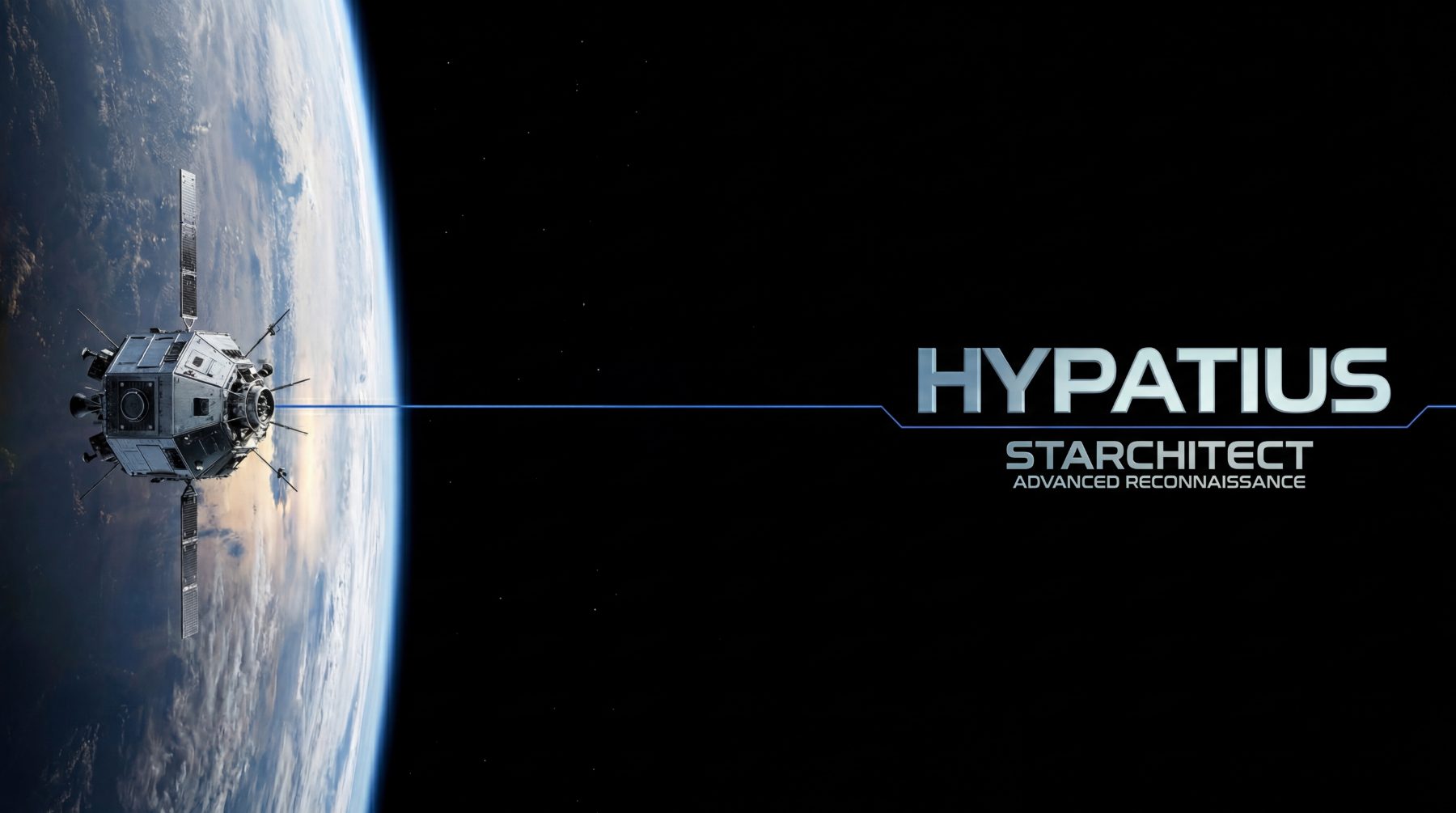
Live · Advanced reconnaissance STARCHITECT

The operating system for space wargaming and BMC3I

Space wargaming and BMC3I simulation built for the next decade of contested orbital operations. High-fidelity orbital mechanics (Orekit) and distributed adversarial AI turn raw space data into repeatable, defensible courses of action.

Over 870,000 lines of orbital simulation, instrumented for battle management, command, control, communications, and intelligence. Every number traces to a physics-engine output — and every AI-assisted run to a reviewable record.

Status
Operational
Physics core
Orekit
Mission set
SDA / PWSA
Integration
BMC3I
Request a briefing starchitect.us
01 · WARGAMING ENGINE
Adversarial scenarios

Multi-actor scenarios with adversarial AI, stochastic event modeling, and human-in-the-loop branches for defensible course-of-action validation.

02 · BMC3I INTEGRATION
Joint by design

Native interfaces to the battle-management and command-and-control architecture, with standards-aligned data formats and decision-loop outputs scored against measures (MOMs/MOEs/MOPs).

03 · ON THE RECORD
Every AI run, reviewable

AI-assisted analysis ships with a complete, reviewable record of every run — inputs, tools called, outputs. No guessing what the AI did; the record is the audit trail.


Hybrid-architecture multi-domain operations

Edge to core, and back.

Five domains sense at the edge — the domain space. One hybrid layer, tolerant of denied, disrupted, intermittent, and limited (DDIL) links, carries it to the core — the information and decision space. There, threat becomes measured courses of action (MOMs · MOEs · MOPs), verified by an operator, and battle management, command, control, communications, and intelligence (BMC3I) is pushed back to the edge at the speed the threat level demands.

Domain space · EdgeFind · Fix · Track
Space
SDA tracks · maneuvers · RF/EO custody
C4ISR
Air
ISR feeds · missile warning · air picture
C4ISR
Land
Ground sensors · fires · force posture
C4ISR
Maritime
Surface/subsurface tracks · AIS · radar
C4ISR
Cyber
Network telemetry · link health · intrusion
C4ISR
Hybrid layerTransport
Mesh, any path
Agnostic data paths · no single link
Store-and-forward
Nodes rejoin without loss
Unified data
One record across domains
Cross-level sharing
DoD · IC · coalition · commercial
DDIL-tolerant · sub-ms
Decision space · CoreInformation / decision space
1
Threat / response matrix
Threat level × pre-authorized response, per domain
2
TT&P + COA generation
Branches per scenario · kill-chain graph
3
Fast-forward adjudication
Physics + network wargame · Orekit · 200 Hz
4
Probability of success
Per scenario · measures: MOMs · MOEs · MOPs
5
Operator-verified decision
AI-assisted · complete, reviewable record of every run
Combatant CommanderNational Command AuthorityMission partners · coalitionBusiness transaction model
Return · BMC3I to the edge

Battle management, command, control, communications, intelligence — pushed back into the domain space. The threat level decides who acts and how fast.

Target · Engage · Assess
Low
Who acts
Core deliberates · commander commits
Latency
Hours → days
What moves
Updated TT&P · re-plan · retasking
Elevated
Who acts
Core pushes ranked COAs · operator verifies
Latency
Minutes
What moves
COAs with probability of success · tasking
Imminent
Who acts
Edge acts on pre-authorized response matrix
Latency
Seconds · <500 ms sensor-to-COA
What moves
Effects · then report to core

TT&P = tactics, techniques & procedures · COA = course of action · Core = information / decision space · Edge = domain space. Print boards: Master flow · Latency curve · Domain lanes.

02 · Latency curve · Mission latency vs. urgency of needPDF ↗
STARCHITECT/ A HYPATIUS PLATFORMHybrid-Architecture Multi-Domain Operations · v2 · Nonproprietary
Mission latency vs. urgency of need

The need peaks in seconds. Most architectures answer in hours.

Time-sensitive targeting lives left of the minute mark. The threat level maps to that curve — and decides whether the edge acts, the core pushes, or the commander deliberates.

Probability of delivery · urgency of need  ·  f(performance, resilience)
100%
75%
50%
25%
SecMinHour12 hrsDayWeekMonthQtrYear
Mission latency · f(connectivity, autonomy, performance, collaborative behavior)Log scale · illustrative
Time-sensitive targeting
STARCHITECT closes sensor-to-COA in <500 ms — inside the peak, not after it.
Imminent
Edge acts · response matrix
Elevated
Core pushes COAs
Low
Commander deliberates · re-plan
Find
Fix
Track
Sensing · the edge
ConnectivityLow latencyAutonomyIncreased autonomy at the nodePerformanceHigh-quality sensingResilienceHigh-pedigree informationCollaborativeRobust identification
Target
Engage
Assess
Communication / tasking · the core, pushed back
ConnectivityLow latency · machine-to-machineAutonomyIncreased automation of taskingPerformanceProbability of success per COAResilienceHigh information assuranceCollaborativeDiverse multi-domain paths
Tasking cycle todayPlanning → sending → accepting → executing → assessing → downlink → processing → dissemination sits at hours-to-quarter. The hybrid architecture collapses the middle steps to machine time; the response matrix removes them entirely for imminent threats.
Kill-chain phases per JP 3-60 · curve shape illustrative, derived from AFRL Small Satellite Portfolio hybrid-architecture concept · COA = course of actionSources: AFRL SSP · JP 3-60 · Hypatius platform directives
03 · Domain lanes · Five domains, five artifacts eachPDF ↗
STARCHITECT/ A HYPATIUS PLATFORMHybrid-Architecture Multi-Domain Operations · v2 · Nonproprietary
Domain space · the edge, lane by lane

Five domains. One architecture, five artifacts each.

Every lane carries the same chain — asset, model, code, analytics, data — and ends in an edge node that keeps fighting when the link is gone. That repetition is what makes the layer hybrid.

Domain1 · Asset2 · Model3 · Code4 · Analytics5 · DataEdge node
Space
SDA sensors
RF / EO custody · maneuvering objects
Orbital mechanics
Orekit · high-fidelity propagation
Maneuver detection
Custody handoff · autonomous at node
Track quality
Conjunction risk · MOPs
Ephemeris record
Catalog deltas · every run logged
Space edge
Fights alone under DDIL
Air
ISR · missile warning
Airborne and overhead feeds
Flight + propagation
Kinematics · radar horizon
Track correlation
Single air picture at the node
Warning time
Detection probability · MOEs
Track record
Air picture history · provenance
Air edge
Fights alone under DDIL
Land
Ground sensors · fires
Force posture · effectors
Terrain + posture
Line of sight · movement
Fires deconfliction
Pre-authorized responses
Effects · coverage
Mission outcome · MOMs
Position + order log
Who moved, when, on what basis
Land edge
Fights alone under DDIL
Maritime
Surface · subsurface
AIS · radar · sonar contacts
Sea state + propagation
Environmental model
Contact fusion
Custody across sensors
Track confidence
Identification quality · MOPs
Contact record
AIS + track history
Maritime edge
Fights alone under DDIL
Cyber
Network telemetry
Link health · intrusion signals
Network model
NS-3 · contested-link behavior
Path selection
Five-tier degradation ladder
Link availability
Latency · loss · MOPs
Event record
Telemetry + path decisions
Cyber edge
Fights alone under DDIL
Every edge node feeds the hybrid layer Same five artifacts in every lane means the core reasons across domains on one record — and any lane keeps running on its own when the link drops.
DDIL = denied, disrupted, intermittent, limited · SDA = space domain awareness · measures: MOMs · MOEs · MOPsSources: USSPACECOM FY29–33 IPL · Hypatius platform directives

Sources: USSPACECOM FY29–33 IPL · DAF FY27 RDT&E · JP 3-60 · AFRL Small Satellite Portfolio hybrid-architecture concept · Hypatius platform directives. Curve shapes illustrative.

Live · Capture intelligence

ALIDADE

AI-native federal capture, end to end

The capture-intelligence platform for GovCon. Neo4j relationship graphs and market signals sight the bearing to a win — then ALIDADE builds the compliant, double-blind teamed proposal on one instrument.

Find the opportunity, score win-probability honestly, chart the teaming partner, and protect the work. No guessing.

Status
Operational
Scoring
7-factor PWIN
Graph
Neo4j
Teaming
Double-blind
Request a briefing alidade.us
CRATON program execution
In development

CRATON

Deterministic ERP for program execution

The operational backbone for high-tempo defense and federal program execution. A deterministic, audit-ready ERP foundation engineered for DCAA compliance and cryptographic data isolation.

Not bolted on for procurement — mission-grade governance is the architecture.

Status
In development
Compliance
DCAA-aligned
Isolation
Cryptographic
Posture
Audit-ready
The operating system

How the layers compose.

Discovery to award, orbit to backbone — one connected reasoning layer.

STARCHITECT
Reasoning layer · live

Space wargaming and BMC3I simulation — the operating system for orbital conflict.

Detail →
ALIDADE
Capture layer · live

AI-native federal capture intelligence — find, score, team, and propose on one instrument.

Detail →
CRATON
Execution layer · in development

Deterministic, audit-ready ERP for program execution — DCAA-aligned, cryptographically isolated.

Detail →

See the operating picture for your mission.

Request a briefing