
Human-AI Teaming: The Aerospace Mindset Machines Still Need
November 23, 2026
The real constraint isn't the model
Every week brings a new leaderboard of model benchmarks, and every week I get asked some version of the same question by customers building spacecraft, ground systems, and mission architectures: which AI should we trust with this problem? The honest answer is that the model matters less than the team you build around it.
At Hypatius, we sit at the intersection of aerospace systems engineering and applied AI, and the lesson that keeps repeating is this: Human-AI Teaming (HAT) isn't about handing a tool the keys to a mission. It's about designing a working relationship — with explicit hand-offs, a shared vocabulary, and mutual checks — between human judgment and machine reasoning. The programs that get this right don't ask AI to replace an engineer's intuition. They ask how four very different modes of reasoning — cognitive recognition, detective reasoning, logical questioning threads, and the structural thinking category theory gives us a name for — can be teamed, not traded.
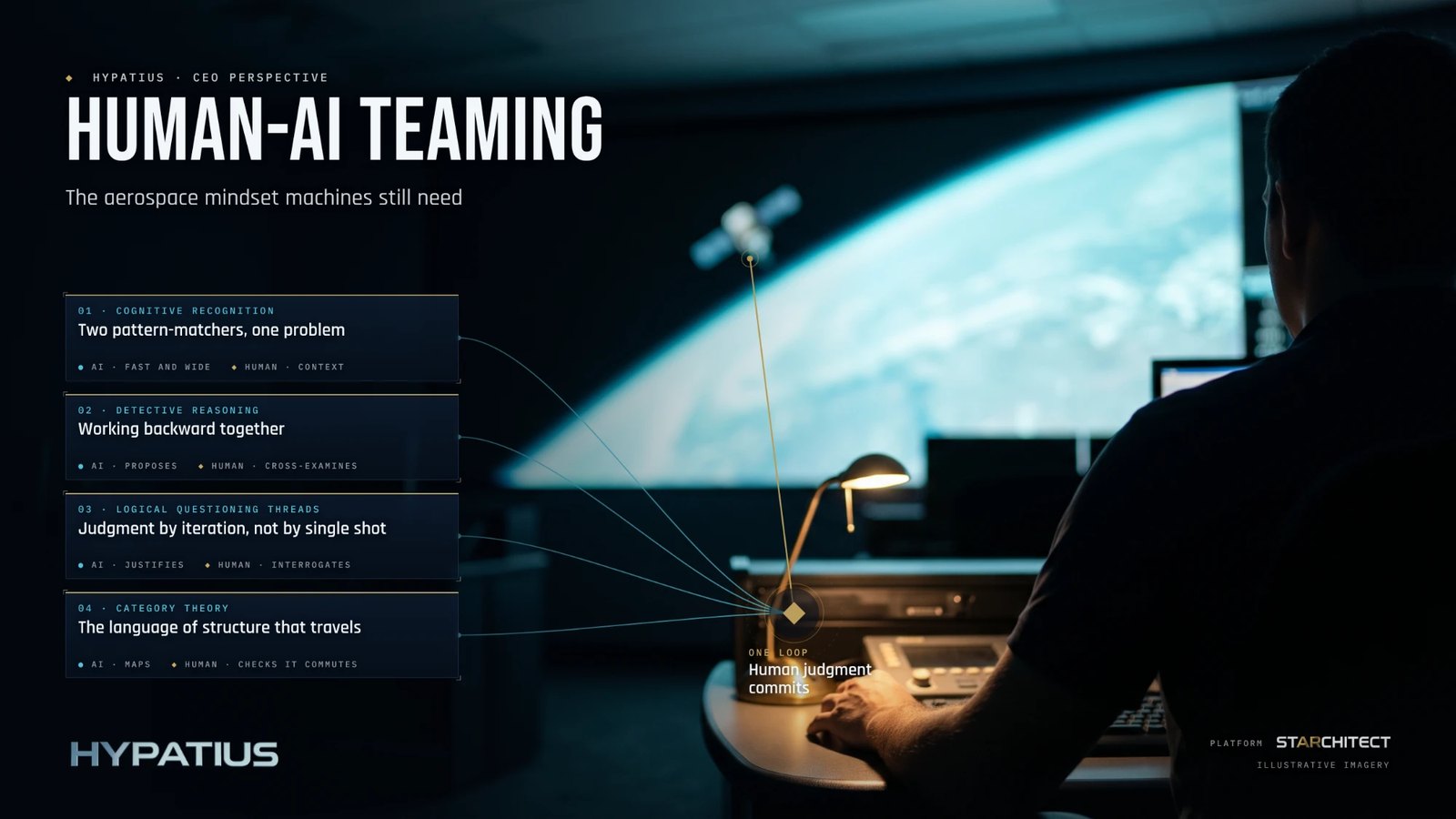
Cognitive recognition: two pattern-matchers, one problem
Human pattern recognition in aerospace is trained over years: an attitude-control engineer who glances at a telemetry trend and senses something is "off" before any threshold trips is drawing on thousands of hours of embodied, contextual experience. AI pattern recognition works differently — it can hold the statistical shape of millions of data points at once, surfacing a drift in a bus voltage or a subtle cross-subsystem correlation a human would never isolate by eye.
Neither is sufficient alone. The AI's recognition is fast and wide but context-blind; it doesn't know this spacecraft just came out of thermal vacuum testing, or that this ground station had a known clock-sync issue last quarter. The human's recognition carries that context but can't watch every channel continuously. Teaming the two means routing the AI's broad-spectrum anomaly detection through a human who can instantly separate a real signal from known noise — and feeding the human's flagged "that looks wrong" moments back into the system so it learns where to look next.
Detective reasoning: working backward together
Good anomaly investigation, like good detective work, is abductive: you start from an effect and reason backward to the most plausible cause, then test that hypothesis against the evidence, then revise. A root-cause investigation on a spacecraft fault, or a mission trade study explaining why a delta-v budget won't close, follows exactly this pattern.
AI is a powerful partner here because it can generate and rank competing hypotheses faster than any team meeting, and it can hold far more of the evidence trail in view at once. But detective reasoning is a conversation, not a lookup: the human has to interrogate each hypothesis the AI proposes, ask what evidence would disconfirm it, and bring in the tacit "we saw something like this on a prior mission" knowledge that doesn't live in any dataset. The best investigations pair an AI that proposes with a human who cross-examines, iterating until the explanation actually accounts for the evidence rather than merely fitting it.
Logical questioning threads: judgment by iteration, not by single shot
Systems engineers know requirements are rarely stated correctly the first time. They're elicited through a chain of questions: why do we need this, what happens if we relax it, what does the next system down the chain assume we've already guaranteed? That same Socratic chaining is what makes human-AI teaming work in practice.
A single prompt-and-answer exchange with an AI system produces a single-shot answer — useful, but shallow. A thread of logical questions, where each answer sharpens the next question and the AI is pushed to justify its reasoning, surface its assumptions, and respond to a human's follow-up skepticism, converges on something closer to engineering judgment. This is also where the human's role shifts from operator to interrogator: the value isn't in asking the AI one good question, it's in knowing which follow-up question will expose a hidden assumption before it becomes a design error.
Category theory: the language of structure that travels
Here's where I'll ask for a little patience, since this one is less common to see in a LinkedIn post. Category theory is the branch of mathematics concerned not with objects themselves but with the relationships between them — and, crucially, with which relationships preserve structure when you move from one domain to another. A "functor," in its language, is a mapping between two systems that respects how their parts connect, so that reasoning done in one domain still holds once translated into the other.
I bring this up because it's the clearest formal description I know for what good human-AI teaming actually requires. When a model carries a pattern learned in one domain — orbital mechanics, say — and a human applies an analogous structure to a software architecture or a business decision, the value of that transfer depends entirely on whether the structure, not just the surface language, has been preserved. Category theory gives us a rigorous way to ask: does this mapping actually commute, or does it just sound right? A systems architect, trained to think in interfaces, dependencies, and composition, is already thinking categorically — and that instinct is exactly what keeps an AI's cross-domain suggestion honest.

Why this needs an aerospace systems mindset, not just an AI strategy
None of the four modes above function well without someone who can referee them, and that's where a broad skills mix and deep subject matter expertise stop being a nice-to-have and become the control mechanism. Subject matter expertise is the ground truth: it tells you when the AI's pattern match is physically plausible and when it's a statistical artifact. A background in aerospace and space systems architecture adds something more specific — a trained habit of decomposing a mission into components, interfaces, and constraints, and verifying that composed reasoning (human judgment plus AI inference plus human validation) still closes the loop the way a trajectory, a link budget, or a requirements tree has to close.
That's the categorical thinking from the prior section, applied practically. At Hypatius, we've found the teams who get the most genuine insight out of AI aren't the ones with the newest model — they're the ones who bring systems-architecture discipline to how they question it, cross-check it, and compose its outputs into something that actually serves the customer's mission objective, not just a plausible-sounding answer. That discipline is the difference between an AI that produces interesting output and an AI that produces a result you'd stake a mission on.
Where we're headed
Human-AI Teaming, done well, isn't a staffing question or a tooling question — it's an architecture question, and it's one aerospace has been quietly answering for decades through systems-engineering discipline. At Hypatius, that's the lens we bring to every customer mission: pairing deep subject matter expertise with AI's reach, and insisting that every insight survive the same scrutiny we'd apply to a trajectory design or a fault tree.
I'd welcome your perspective — where have you seen human-AI teaming actually earn trust on a mission-critical problem, and where has it fallen short? Drop a comment; I read every one.